 KG Repair Rewards – discover how every repair can be safer, more efficient and truly rewarding!
 KG Ultra App — Powering operational excellence with KG Smart Support!


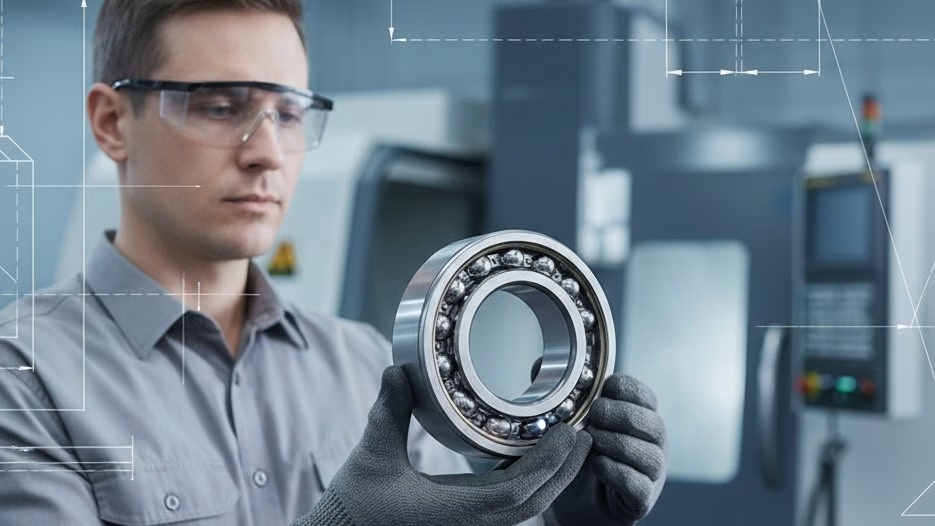
The need for precision and efficiency in high-speed machinery is of utmost importance for the industry stakeholders. With operations becoming increasingly rapid and supply chains under pressure, industries such as manufacturing, automotive, and aerospace consistently seek components capable of performing under rigorous conditions without compromising on quality. Among these critical components, angular contact ball bearings have established themselves as essential elements in ensuring the future readiness of high-speed machinery through precision engineering and superior design.
Discussions around advanced bearing technology often revolve around achieving the right equilibrium between load capacity, speed performance, and operational reliability. When assessing machinery requirements, angular contact ball bearings repeatedly prove their efficiency and adaptability. Their unique ability to manage both radial and axial loads at once makes them indispensable in demanding industrial environments. These bearings not only enhance machine performance but also contribute to reduced downtime and extended service life. By combining durability with accuracy, angular contact ball bearings have become the cornerstone of modern machinery, providing a balance of strength and precision that distinguishes them from conventional bearing solutions.
Technology Behind Angular Contact Ball Bearing
Angular contact ball bearings offer an advanced solution for machinery that operates under combined load conditions. Unlike conventional deep groove ball bearings designed mainly for radial loads, angular contact bearings have inner and outer ring raceways positioned offset to each other along the bearing axis. This offset design forms a defined contact angle between the balls and raceways, allowing the bearings to handle significant axial loads in one direction while efficiently managing radial forces.
The contact angle is the distinguishing factor that determines a bearing’s suitability for specific uses. Bearings with smaller contact angles are optimal for high-speed applications, minimizing friction and enhancing rotational speed. In contrast, those with larger contact angles provide higher axial load capacity, making them ideal for heavy-duty machinery where greater thrust forces are encountered.
Benefits, Performance, Design
- Angular contact ball bearings are designed with advanced engineering features that ensure outstanding performance in demanding conditions. Manufactured with precision, these bearings maintain minimal internal clearances and optimized ball-to-raceway contact geometry, reducing friction and improving operational efficiency. The use of advanced cage materials such as solid brass, steel, or phenolic resin enhances ball guidance and stability, particularly in high-speed operations.
- One of their key advantages is versatility, as they can support combined loads (both radial and axial) that would typically require multiple bearing configurations. The distinct angular displacement between the raceways allows even load distribution across the contact points, minimizing stress concentrations and extending bearing life.
- Their precision-engineered design ensures consistent performance and reliability under varying speeds and mechanical loads. This makes them ideal for applications that range from moderate-speed machinery to ultra-high-speed systems where accuracy, durability, and low friction are critical.
In a nutshell, angular contact ball bearings combine meticulous design, durable materials, and geometric accuracy to deliver long-lasting performance across diverse industrial environments.
Applications: Angular Contact Bearings
Angular contact ball bearings play a vital role across industries where reliability and precision are critical under extreme operating conditions. In the aerospace sector, these bearings are indispensable in jet engines, where they must endure high rotational speeds, drastic temperature fluctuations, and complex load combinations while ensuring absolute positioning accuracy.
Angular contact bearings are equally essential in the automotive industry. They are commonly used in transmission systems, wheel hubs, and steering assemblies applications that involve simultaneous radial and axial loads. Their ability to handle such conditions ensures long-term performance and durability, even in high-demand vehicles.
Among the most demanding applications, machine tool spindles rely heavily on angular contact ball bearings. In modern CNC machining centers, these bearings deliver the precision, rigidity, and speed required to meet exacting manufacturing standards. By maintaining dimensional stability and minimizing deflection during heavy cutting operations, they contribute significantly to achieving superior accuracy and surface finish quality.
The unique design and high-performance characteristics of angular contact ball bearings make them indispensable for aerospace, automotive, and precision machining industries alike, ensuring efficiency, reliability, and exceptional operational performance under the most challenging conditions.
Significance of Correct Angle
Selecting the correct contact angle is a vital decision that directly affects the performance of a bearing. Applications demanding high-speed operation generally require smaller contact angles, as these reduce internal friction and heat buildup during rapid rotation. Such configurations are particularly suitable for spindle systems in high-frequency machining, where rotational speeds are exceptionally high.
Conversely, when axial load capacity is more important than speed, larger contact angles offer superior thrust load handling. These are commonly used in industrial pumps, compressors, and heavy-duty machinery that experience significant axial forces during operation.
Therefore, determining the appropriate contact angle involves thoroughly evaluating the application’s specific load conditions, speed requirements, and environmental factors to ensure optimal bearing performance and durability.
Installation and Configuration: Angular Contact Bearings
Angular contact ball bearings are generally installed in pairs to ensure balanced load distribution and optimal performance. A back-to-back mounting arrangement enhances rigidity and moment load capacity, making it ideal for applications demanding high structural stability. In contrast, face-to-face configurations provide better tolerance for misalignment while maintaining the ability to handle axial loads in both directions. For applications where unidirectional axial loads are predominant, tandem arrangements offer a distinct advantage by effectively doubling the axial load capacity compared to a single bearing setup. During installation, precise preload adjustment is essential to maintain accurate internal geometry and eliminate internal clearances. This process prevents vibration, enhances bearing precision, and ensures long-term operational reliability. Together, these mounting methods allow engineers to select the most suitable configuration based on load direction, rigidity, and alignment requirements for superior bearing performance in demanding industrial environments.
Material and Manufacturing
Modern angular contact ball bearings are crafted using advanced materials designed to perform reliably under high-speed and demanding conditions. Their robust construction ensures exceptional durability and resistance to fatigue, while specialized heat treatments enhance hardness and maintain dimensional stability. For extreme environments, ceramic ball variants provide significant advantages, offering lighter weight and superior temperature resistance compared to traditional steel balls.
High-quality manufacturing processes guarantee precise dimensional accuracy and excellent surface finish across every component. Advanced grinding methods produce exceptionally smooth raceway surfaces, minimizing friction and maximizing service life. Additionally, precision-engineered cages maintain consistent ball spacing and stability across the entire operational speed range, ensuring smooth performance and reduced wear over time.
Lubrication Requirements
Proper lubrication is essential for ensuring the optimal performance of angular contact ball bearings. In high-speed operations, specialized lubricants are required to reduce friction and sustain an adequate lubricating film even at high temperatures. Consistent monitoring of bearing temperature, vibration, and lubricant quality helps detect potential problems early, preventing costly damage. Implementing predictive maintenance strategies that include vibration analysis and temperature tracking allows for timely bearing replacement, minimizing unplanned downtime and enhancing overall system reliability.
Performance & Consistency
The ongoing advancements in manufacturing processes and materials science are continuously enhancing the performance of angular contact bearings. Optimized design and precision rolling elements enable higher speed capabilities and longer service life in demanding industrial applications. Additionally, advanced surface treatments and specialized coatings improve wear resistance and minimize friction for smoother, more efficient operation. These innovations not only boost reliability but also support predictive maintenance strategies, enabling manufacturers to collect valuable operational data. This data-driven approach helps identify performance trends, prevent unexpected failures, and optimize overall machinery efficiency and longevity across diverse applications.
Conclusion
Angular contact ball bearings are vital in modern high-speed machinery, offering the precision, durability, and reliability needed for complex industrial operations. Their ability to efficiently manage both radial and axial loads while maintaining high performance under demanding conditions makes them indispensable across various sectors. As manufacturing technologies progress and machinery evolves, angular contact ball bearings will continue to play a key role in achieving advanced precision engineering standards.
KG International is a global leader in supplying premium angular contact ball bearings and complete bearing solutions worldwide. Backed by over 50 years of expertise and a network spanning more than 53 countries, KG International ensures exceptional product quality, technical support, and availability. From standard designs to customized bearing configurations, the company’s unwavering dedication to innovation, performance, and customer satisfaction positions it as the preferred partner for all angular contact bearing requirements and beyond.
